There are scenic places around Darjeeling that everyone knows about.
And then there are places that make you wonder—“Why have I never heard about this place before?”
Rangaroon is one of them.
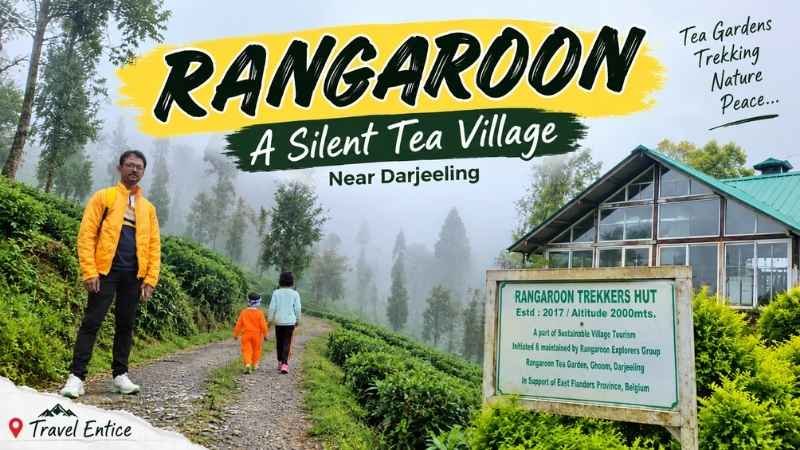
Tucked away beyond 3rd Mile, after passing through the beautiful Senchel forest, Rangaroon is a tiny tea village where life moves slowly, the mountains remain quiet, and the songs of unknown birds among the tea bushes often feels louder than the sound of tourists.
Located roughly 16–17 km from Darjeeling town, Rangaroon sits at around 2,000 metres above sea level, in the shadow of Tiger Hill. The approach itself is part of the experience: once you leave the familiar Darjeeling–Ghoom area and turn towards 3rd Mile, the busy tourist landscape gradually disappears. The road winds through forest and finally descends towards the tea garden village of Rangaroon.
And suddenly, you are somewhere completely different.
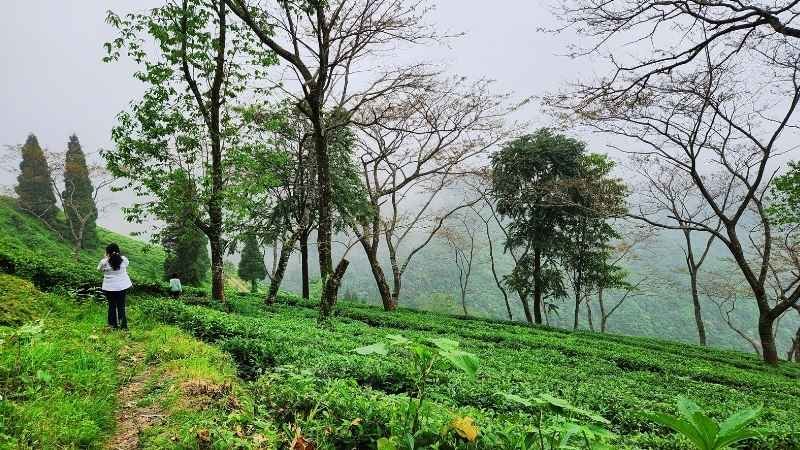
I felt exactly the same when we reached Rangaroon—after travelling through the forest, the sudden appearance of the tea gardens and the quiet little village felt like discovering a completely different side of Darjeeling.
—No crowded Mall.
—No line of tourist cars.
—No busy sightseeing points.
Just forests, mountains, clouds, and after an hour’s drive—a small Himalayan village surrounded by beautiful tea gardens.
Table of Contents
Why is Rangaroon so special?
Rangaroon is not a place you visit to tick off ten sightseeing spots in one day (like you would plan for Darjeeling).
It is a place you visit to slow down.
The village is still relatively unknown to mainstream tourists, and accommodation options remain very limited compared with Darjeeling or even offbeat destinations like Dawaipani or Tinchuley. That limited tourism is actually one of Rangaroon’s biggest attractions.
Here, you can wake up to the sound of birds, walk through a tea garden, talk to local people, watch clouds drifting across the valley and simply sit quietly without feeling that you have to “do” something.
For travellers who are tired of crowded hill stations, this peacefulness is the real attraction of Rangaroon.
Rangaroon – A Village Surrounded by Tea Gardens
The first thing that catches your attention in Rangaroon is the tea garden.
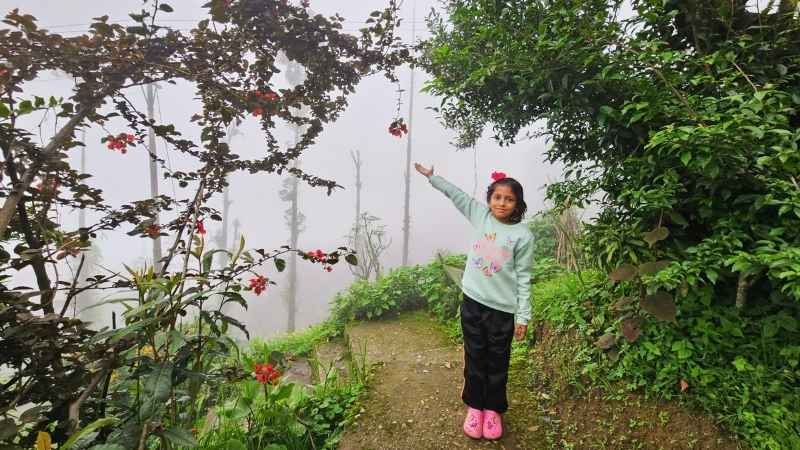
Green tea bushes cover the slopes around the village, creating a landscape that is very different from the crowded viewpoints of Darjeeling. Depending on the season and weather, the garden can look completely different—from mist-covered and mysterious to brilliantly green under the Himalayan sun.
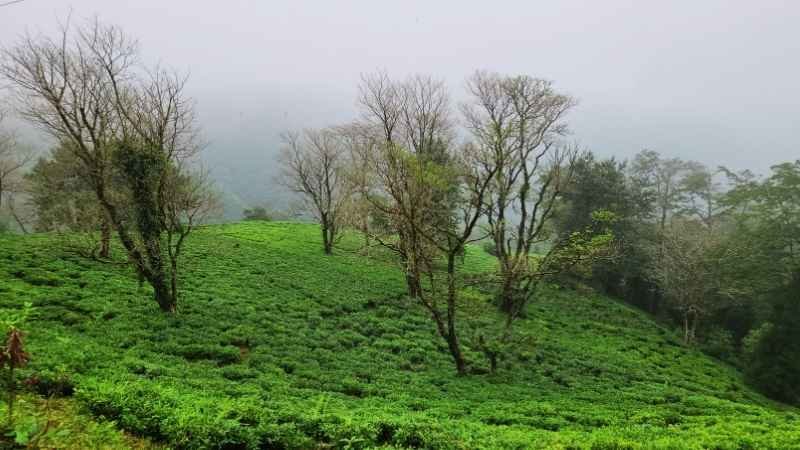
Rangaroon’s tea-growing history is also quite old. The area has been associated with the Darjeeling tea industry for generations, and the tea garden remains an important part of the landscape and local life.
The official tourism information describes Rangaroon as a tea-growing destination situated below Tiger Hill, where the moist mountain climate is suitable for tea cultivation.
But for a visitor, statistics and history are secondary.
Walking through those endless rows of tea bushes, with mountains rising beyond them, is an experience of a lifetime!
Also read: Top 6 Offbeat Spots in North Bengal
The Historical Tea Factory
One of the most interesting things about Rangaroon is something that many visitors may completely overlook—the old tea factory.
According to the Gorkhaland Territorial Administration’s tourism information, Rangaroon has a century-old, two-storeyed hydraulic tea manufacturing factory, built by German-born Frederick von Frostmaan. Although the factory has remained non-functional for many years, its old machinery provides a glimpse into the history of tea manufacturing in the Darjeeling hills.
The particularly fascinating part is the old hydraulic system.
Water was once used as an important source of power in the tea manufacturing process. Today, the factory stands as a reminder of an earlier era when tea production in the Himalayan hills depended on ingenious systems adapted to the terrain.
For anyone interested in Darjeeling tea, colonial-era history and old industrial heritage, this is a fascinating part of Rangaroon.
Related: Tandrabong or Tendrabong: The Offbeat Wonder of North Bengal
Rangaroon Through the Eyes of a Traveller – It’s My Personal Experience
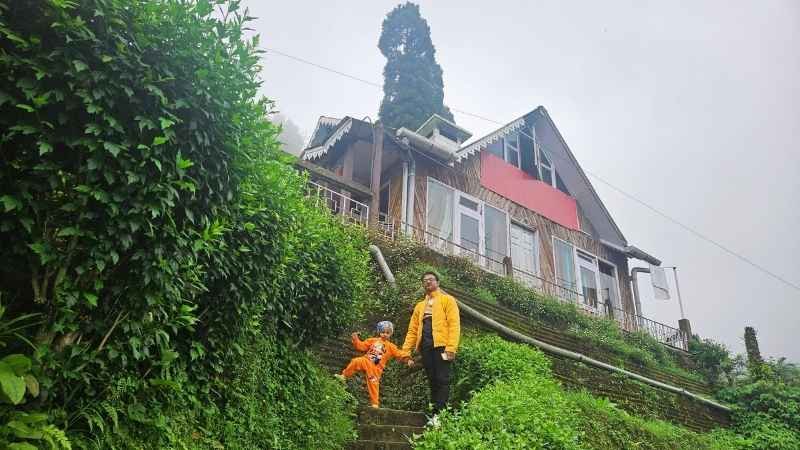
But honestly, the old factory is only one part of the Rangaroon experience.
What stayed with me most was the silence. You don’t realise how noisy a popular tourist destination can be until you spend some time somewhere like Rangaroon.
There are very few tourists here. There are only a handful of homestays. And there are long stretches where you may find yourself walking through the tea garden with nobody around.
That is when Rangaroon begins to feel special.
You are not simply visiting another “offbeat destination”. You are temporarily becoming a part of a Himalayan village.
You may read & plan: Charkhole: A promising offbeat Destination in North Bengal
Kanchenjunga on a Clear Day
Like many places in the Darjeeling hills, Rangaroon can also offer beautiful Himalayan views when the weather cooperates. On a clear day, Kanchenjunga and the surrounding snow-covered peaks can become visible from suitable viewpoints around the area, even from your homestay.
But there is a small catch.
The mountains decide when they want to appear.
Clouds and mist are common in the hills, and you may spend hours waiting for the clouds to move. And perhaps that is part of the fun.
You sit quietly with a cup of tea, looking towards the mountains. Then, suddenly, the clouds open. For a few minutes, the snowy peaks appear.
And before you can properly take another photograph, they disappear again.
Must visit: Rangli Rangliot Tea Garden: A Serene Retreat
Trekkers Hut – A Perfect Base for Exploring Rangaroon
If you are planning to stay in Rangaroon, Trekkers Hut is one of the names you are likely to come across.
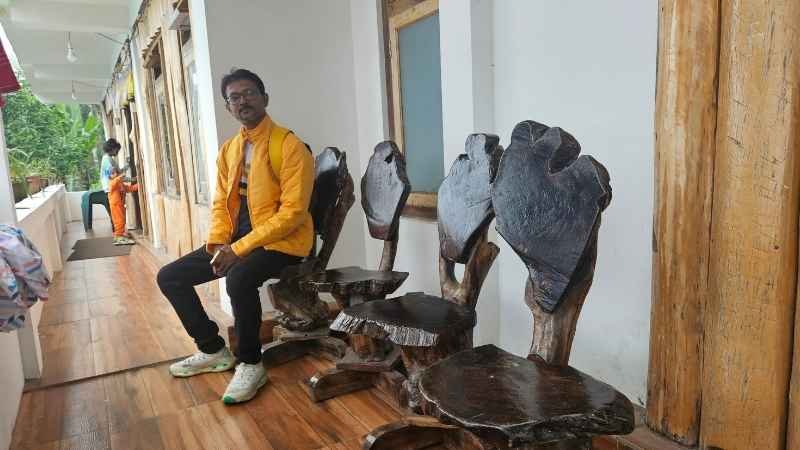
The property is run in association with the local explorer group (initially funded by a Belgian couple, as mentioned on the notice board), and it offers something more than simply a place to sleep.
It is an ideal base for experiencing Rangaroon.
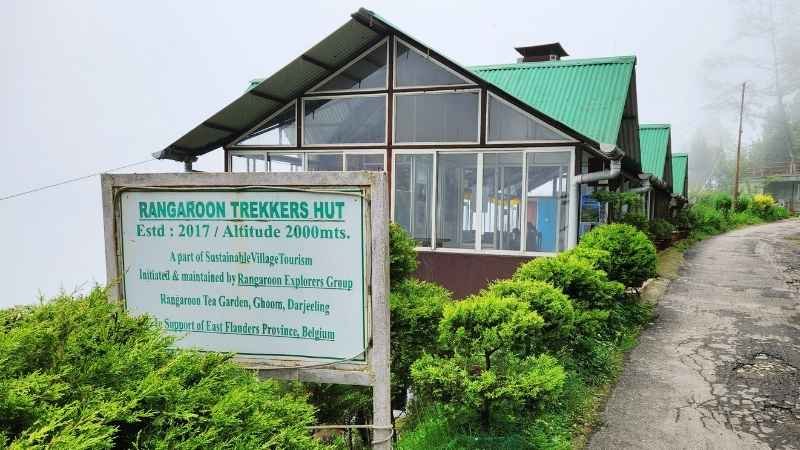
The official tourism information also lists Trekkers Hut among the accommodation options in Rangaroon and notes that it is operated by the local explorer group. Rangaroon Trekkers Hut is also included in the Darjeeling Police’s current list of certified homestays.
What makes a stay here particularly interesting is the opportunity to explore the surrounding landscape with people who actually know the area. In addition, the people at Trekkers Hut are truly wonderful and always try to offer the best possible service.
During our visit, a local village woman performed several beautiful songs in the Trekkers Hut dining hall, giving us a delightful evening. My 9-year-old daughter also joined her, as she has some experience performing on stage.
And such warm, personal experiences made our stay at Rangaroon even more special—and brought us closer to the real spirit of the village.
Must check: 8 Best Places to Visit in Kurseong: Reveal A Cool and Nostalgic Summer
Trekking Through Rangaroon
If you enjoy walking through forests and tea gardens rather than simply visiting viewpoints by car, Rangaroon can be a wonderful base.
The Raageyrung Explorer Group, associated with Trekkers Hut, offers trekking and outdoor experiences around the region.
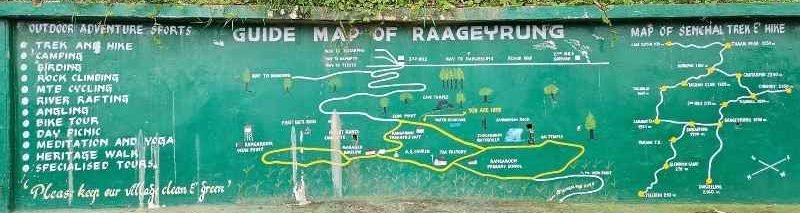
One of the experiences that particularly caught my attention is their full-day circuit trek. The route takes you through the tea garden and towards the 3rd Mile forest, with beautiful views of the valleys and waterfalls far below, eventually making its way towards Dawaipani.
This is not the kind of trek where the destination is simply a viewpoint.
The trail itself is the destination.
You walk through the tea bushes. You enter the forest.
You hear birds and the sound of flowing water. You see waterfalls in the valley.
And slowly, the landscape changes as you make your way towards Dawaipani.
For someone who wants to experience the quieter and more natural side of Darjeeling, this kind of trail can be much more memorable than moving from one crowded sightseeing point to another.
Rangaroon is also known for trekking routes connecting the village with the surrounding areas, including 3rd Mile and Dawaipani.
Related: Lamahatta Eco Park: A Nature Lover’s Paradise
More Than Just Trekking
The explorer group associated with Trekkers Hut also offers several other outdoor activities.
Depending on availability and arrangements, these include:
- Camping
- Bird watching
- Rock climbing
- Mountain biking / MTB cycling
- River rafting
- Bike tours
- Day picnics
- Specialised adventure and nature tours
This makes Rangaroon interesting not only for people looking for a quiet homestay but also for travellers who want to combine a peaceful mountain stay with outdoor activities.
Birdwatching, in particular, is worth considering. The surrounding forests and Himalayan environment provide opportunities to spot a variety of mountain birds, and Rangaroon’s tourism information specifically identifies birdwatching as one of the activities visitors can enjoy here.
Also read: Sandakphu Trek: The Untold Way to Reconnect with Yourself!
Beyond the Tea Garden – River Rungdung
There is another side of Rangaroon that is less talked about.
Below the village tea garden flows the Rungdung River, also referred to as Dahria in the local tourism information. The river can be reached by a walk of roughly 40 minutes, and the area is also used by local people for picnics and gatherings.
So, if you are staying for more than one night, don’t restrict yourself to the homestay and tea garden.
Walk.
Explore.
Talk to the locals.
Follow the village paths.
That is how you discover the real Rangaroon.
You may check: Darjeeling Local Sightseeing: 10 Best Places to Visit in Darjeeling Town
The Observatory Cave
Rangaroon also has a small but culturally significant attraction known as the Observatory Cave.
The cave is regarded as a sacred place by local villagers, and it is believed to be associated with Goddess Durga. Local worship is performed here seeking blessings and good fortune.
It is another example of how a visit to Rangaroon is not just about scenery.
The landscape, local beliefs, history and village life are all connected.
Also read: Jaldapara National Park: Explore Indian One-horned Rhinoceros
The People of Rangaroon
Perhaps one of the most beautiful parts of travelling to places like Rangaroon is meeting the people who live there.
The people are warm and welcoming, and the slower pace of village life makes conversations feel very different from interactions in commercial tourist centres.
You don’t come to Rangaroon for luxury.
You come for hospitality, simplicity and connection.
Sit with the locals. Have a cup of tea. Ask about the village. Listen to their stories.
These small moments often become the memories you carry back home.
A related article: Lovers Meet Viewpoint
How to Reach Rangaroon
Rangaroon is quite close to Darjeeling geographically, but the final stretch feels like entering a completely different world.
From Darjeeling, the route goes towards Ghoom and Jorebunglow, followed by 3rd Mile. From 3rd Mile, a downhill road passes through the forest before reaching Rangaroon.
It’s approximately 16 km from Darjeeling and around 8 km from Jorebunglow.
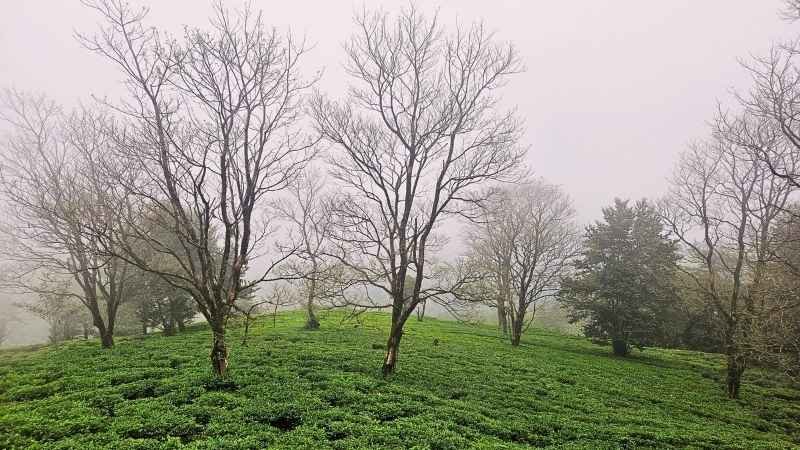
If you are coming from Siliguri/NJP, one common approach is to travel towards Jorebunglow/3rd Mile and then continue towards Rangaroon. Exact travel time can vary considerably depending on road conditions and the vehicle.
For a first visit, I would recommend arranging your local transport in advance rather than depending entirely on public transport for the final stretch.
You can contact Sanjok-Ji, a local car owner and driver—and, of course, a very good person. His contact number is 7384598812.
Nearby attraction: Peshok Tea Garden
When Should You Visit Rangaroon?
Rangaroon has a charm in different seasons.
Spring brings fresh greenery and pleasant weather.
Monsoon can make the tea gardens incredibly lush and atmospheric, although rain can affect road and trekking conditions.
Autumn and early winter can bring clearer mountain views, making it a good period if Kanchenjunga is high on your wish list.
But remember—clear Himalayan views can never be guaranteed. The mountains have their own schedule.
And Rangaroon is beautiful even when Kanchenjunga is hidden behind clouds.
Must read before plan: Explore Tinchuley Sightseeing & Plan A Memorable Tinchuley Trip
How Many Days Do You Need?
For a quick escape, a one-night stay can give you a taste of Rangaroon.
But if you really want to experience the place—walk through the tea gardens, explore the village, spend time at the homestay and take a proper trek—two nights would be much more comfortable.
And if you are an adventure enthusiast, you can use Rangaroon as a base for longer outdoor activities and explore the surrounding trails.
Also read: Chimney Park, Kurseong: Explore the historic charm in serene surroundings
Rangaroon Is Not for Everyone—and That’s the Point
If you are looking for:
crowded markets, shopping, restaurants, busy sightseeing spots and a packed itinerary, Rangaroon may not be your ideal destination.
But if you are looking for:
silence, tea gardens, forests, village life, trekking, birds, clouds, mountain views and a few peaceful days away from the crowd, Rangaroon deserves your attention.
For me, that is exactly what makes this place special.
Rangaroon does not try to impress you.
It simply lets you slow down.
And sometimes, that is exactly what we need from the mountains.
Please Keep Rangaroon Clean
There is one message that the people associated with Rangaroon and the local explorer group strongly emphasise:
Please keep our village clean and green.
Rangaroon is still relatively untouched by mass tourism. That is its biggest strength. And if we want it to remain that way, visitors have a responsibility too.
Please don’t throw plastic bottles or cans, food packets, cigarette packets or other waste along the trekking trails or tea gardens.
Carry your waste back with you and dispose of it properly.
Also, please remember:
- Don’t damage the tea bushes.
- Don’t disturb birds or wildlife.
- Respect local people, their homes and their traditions.
We travel to beautiful places because we want to experience their beauty.
Let’s make sure our visit doesn’t destroy what we came to see.
Final Thoughts
Rangaroon may not be as famous as Darjeeling, but perhaps that is exactly why you should visit this place.
It is a place where a tea garden becomes your backyard, a forest becomes your walking trail, clouds become your companions and a quiet evening can feel more memorable than a long sightseeing itinerary.
Stay at Trekkers Hut, walk through the tea garden, explore the forest, take a trek towards Dawaipani, meet the local people and simply allow yourself to enjoy the silence.
Because sometimes the best travel experiences aren’t found in the places everyone is talking about.
They are found in the places that are still waiting to be discovered.
And Rangaroon is one such place.
Rangaroon at a Glance
| Information | Details |
|---|---|
| Location | Darjeeling district, West Bengal |
| Distance from Darjeeling | Approximately 16–17 km |
| Altitude | Around 2,000 m / 6,500 ft |
| Known for | Tea garden, forests, village life, trekking and birdwatching |
| Major attraction | Rangaroon Tea Estate & historic tea factory |
| Stay | Trekkers Hut and local homestays |
| Adventure | Trekking, camping, birdwatching, MTB, rock climbing and other outdoor activities |
| Nearby experience | 3rd Mile forest, Dawaipani, Rungdung River |
| Mountain view | Kanchenjunga may be visible on clear days |
| Ideal stay | 1–2 nights depending on activities |

Dr. Suvankar Das is a scientific advisor by profession, associated with a CRO organization. He pursued his doctoral degree in Chemistry in 2015. Later, he worked as a postdoctoral researcher & scientist in a couple of institutes/companies.
Besides his scientific journey, Dr. Das is also a passionate traveler and travel blogger. He loves to share all his travel experiences with other travelers so that everyone can enjoy hassle-free holidays with their own tour plans.
He believes, the most beautiful thing in this world is the WORLD itself. so there is no way to live like a clock; rather live it like a compass!